
7 Ideas to Reinvent-Revitalize-Rejuice Your Program’s Handbook
Handbooks. An absolutely ‘necessary tool’ for classroom success or a completely ‘antiquated practice’ you’d sooner just skip? I’m guessing you’ve probably identified with both of these camps at some point in your teaching career. On the one hand, a program handbook is truly ground zero for communicating your expectations and procedures in and outside the fine arts classroom. But, let’s face it, the painstaking work you did to produce and maintain it is a hefty price tag considering many of your members don’t quite read every word as closely as you do.
Ultimately, it’s our job to teach standards to our music, dance, and theatre students. But who says handbooks have to be boring?! I say, this is a golden opportunity to flip your handbook’s old script and transform it into a more effective and memorable teaching tool.
Gone are the days of poring over dense text by candlelight. People are immersed in a world of short-form video, interactive content and visual aids. From TikTok tutorials to engaging infographics, information is consumed quickly and dynamically. Why should your program's handbook content be any different? It's time to transform your dusty manual into a vibrant, engaging experience worthy of your music, dance, or theatre program that resonates with how everyone learns today.
Here are seven transformative ideas for you to test and try out:
1. Act Out Key Scenarios with Video
Benefit: Textual explanations can sometimes fall flat when conveying complex procedures or expected behaviors. Students and guardians often grasp concepts more effectively when they can visualize them in context. Short, engaging video clips with demonstrations by you, or with the help of your student leaders and volunteers, can bring your rules and norms to life. Imagine a video demonstrating the proper way to handle specific equipment, showing the correct procedure for checking in and checking out inventory, or even acting out appropriate vs. inappropriate rehearsal etiquette. These "video vignettes" can clarify expectations, reduce common misunderstandings, and provide a quick, memorable reference point. They are easily digestible, accessible on various devices, and can be shared widely to ensure consistent understanding across your program community. Record and edit your clips on your phone, or use an app like Loom that allows you to more easily record and edit footage on your desktop.
2. Bring Critical Content to Life with Dramatic Readings
Benefit: Not everyone learns best by reading. Auditory learners, as well as busy guardians or students who prefer to consume information on the go (e.g., during commutes or while exercising), would greatly benefit from audio excerpts within your handbook. This isn't just about a monotone voice reading the text; it's an opportunity to infuse personality and engagement.
Read important portions of your handbook material in class with your students. My students would often cite the recitation of the “Public Display of Affections” policy as one of the most memorable parts of the first week of school. It was engaging, funny, and awkward in just the right way. I recommend using this technique for the most significant topic that can afford some humor. We all know the value of live performances, and this is your opportunity to reinforce it in the classroom!
You can also look to the drama club or theatre students to perform a dramatic reading of critical information that guardians can access. Their vocal artistry can transform potentially dry, but essential policies and procedures into an engaging narrative, making the information more palatable, memorable, and enjoyable to listen to. This broadens accessibility and caters to a wider range of learning preferences.
3. Insert a Pop 'Buzzfeed' Style Quiz and Give Out Prizes
Benefit: Learning doesn't have to be a chore; it can be a game! Incorporating "Buzzfeed" style quizzes, known for their fun, informal, and often humorous tone, can be an excellent way to test comprehension and reinforce key information from your handbook. Create short, interactive quizzes covering essential rules, procedures, or important dates. Students can take these quizzes online or even in person, turning the act of learning into a low-stakes, enjoyable competition. Offering small, program-themed prizes for participation, high scores, or even just completing the quiz can significantly boost engagement and incentivize students to truly internalize the handbook's content. (Hint, you can give away last year’s t-shirt overstock as rewards!)
4. Make an Infographic Poster for Your Classroom Wall
Benefit: In a world saturated with information, visual communication stands out. Infographics are powerful tools for condensing complex data or lengthy text into easily digestible, visually appealing formats. Select the most critical rules, norms, or procedural steps from your music, dance, or theatre program handbook and translate them into a vibrant, clear infographic poster. This can be proudly displayed on your classroom wall, serving as a constant, at-a-glance reminder of core expectations. To deepen commitment and ownership, consider having students collectively sign the poster once they understand and commit to its contents. This transforms a simple visual aid into a shared pledge, fostering a sense of community and responsibility.
5. Include a Handbook Reminder of the Month in Your Announcements
Benefit: Information overload is a common challenge for guardians. While they may receive a hardcopy of your handbook at the beginning of the program year, its contents can easily fade from memory amidst busy schedules. Implement a "Handbook Reminder of the Month" segment within your regular announcements to guardians (e.g., via email newsletters, online portals, or printed flyers). Each month, highlight a specific section, policy, or key piece of information from the handbook that is particularly relevant to the upcoming period or common issues. This consistent, bite-sized reinforcement keeps the guide top-of-mind, encourages guardians to refer back to it proactively, and helps them feel more connected and informed throughout the program year.
6. Visualize Your Grading System as a Classroom Post and Standalone File for Signature
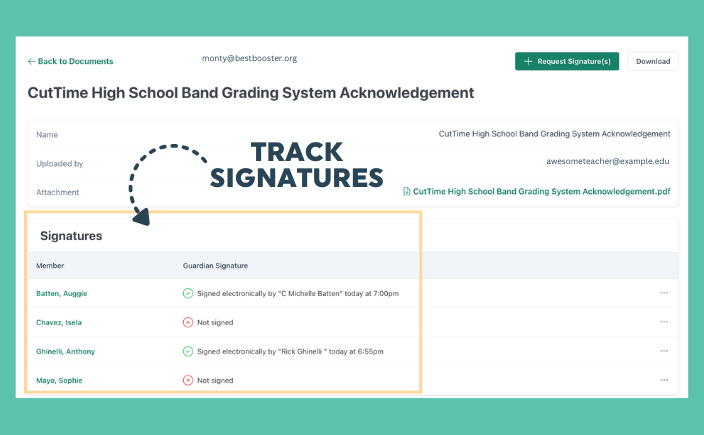
Benefit: Grading systems can often be a source of confusion and anxiety for both students and guardians. To promote transparency and understanding, create a clear, visually intuitive graphic that meticulously explains your program's grading system. This graphic should clearly outline how grades are determined, the weight of different assignments, and any specific criteria for success. Post this graphic prominently in your classroom so students have a constant visual reference. Furthermore, provide it as a standalone digital or print file that both students and guardians can sign, indicating their understanding and acknowledgment of the grading policies.
CutTime can help expedite this task with their eSignature tool so you don’t have to chase the paper and have a record of who signed at your fingertips. This serves as a critical reference point, minimizes disputes, and empowers everyone to track progress and understand expectations.
7. Survey Your Students and Guardians for Feedback
Benefit: A truly effective handbook is not a static document but a living, evolving resource. To ensure its continued relevance and clarity, actively solicit feedback from your students and guardians. Conduct anonymous surveys mid-year or at the end of the program year, specifically asking about points of confusion, sections that were unclear, topics that perhaps weren't covered adequately, or issues that arose that could be better addressed in the guide. Asking your trusted members and their guardians about specific sections often yields higher quality responses than asking someone to look over the entire document. This direct feedback is invaluable for identifying areas for improvement, clarifying ambiguous language, and ensuring the handbook remains a practical and useful tool for everyone involved in your program. This iterative process also demonstrates your personal commitment as an educator to continuous improvement and a high quality student-family centered experience.
One more piece of advice, this one from my personal experience. Make sure you make your handbook content as ‘actionable’ as possible. By this I mean:
- If you mention private lessons, provide a list of qualified teachers with links to their website or social media pages and include email addresses and phone numbers
- If you require specific materials, include links for purchase
- If you have an online store for purchasing accessories, reeds, valve oil, or certain clothing items, include a link that people can easily copy and bookmark (if you don’t have one set up yet for your program, try Simple Raise, CutTime’s sister fundraising platform! With Simple Raise, we cover the processing fees so you keep 100% of the donations from your sales for your program. And, it’s integrated with CutTime so you only need one user id and password to access them both!)
Transforming your handbook might seem like a significant undertaking, but the effort will pay off. By embracing these innovative approaches, you're not just updating a document; you're actively enhancing communication, fostering deeper understanding, and creating a more engaging and accessible resource for your entire fine arts community. Your students and guardians will thank you for making essential information clear, digestible, and even enjoyable. It’s the best time investment you can make in what will be a more organized, harmonious, and ultimately, more successful program.
Transform Your Program's Admin Life with CutTime
Your program’s handbook isn’t the only thing needing a digital makeover. Time to revitalize your communication, financials, fundraising, and inventory so you can get more quality time on the podium. Don’t wait, take the next step!